Writing Music With The Help of AI

I’ve written poetry since before I was 12 – about when I first took piano.

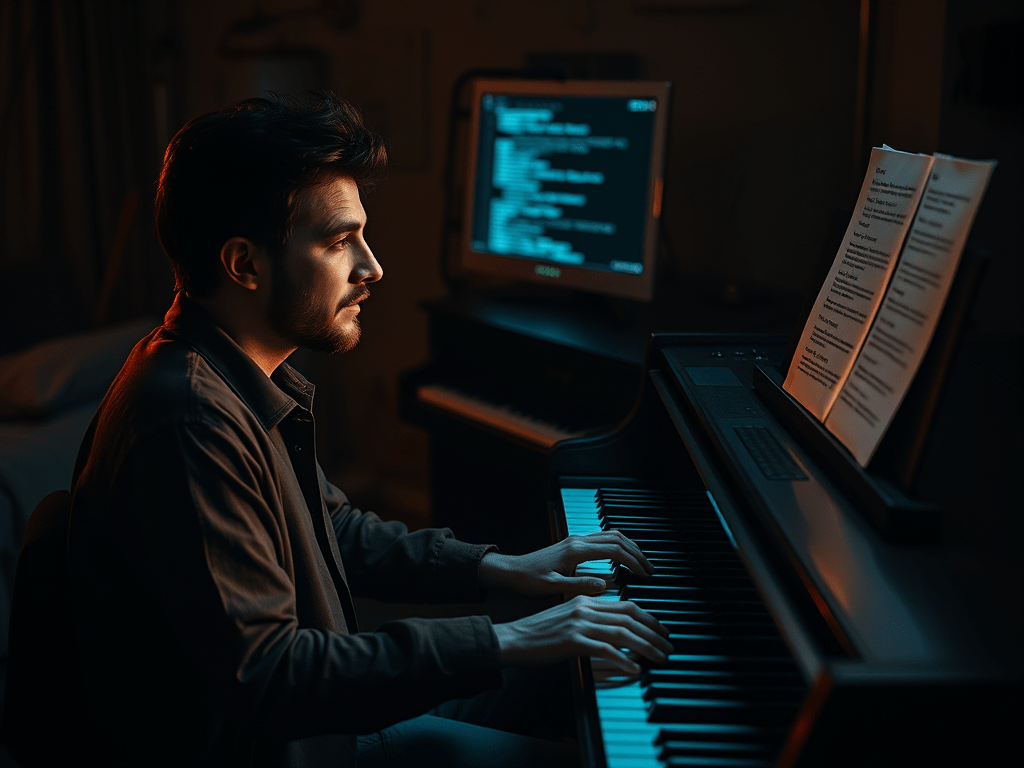
Occasionally I like the poem well enough that I would sit down at a piano for days crafting it into a song. This involves building out the melody, harmonies, key changes and instrumentals of the verse, chorus, bridge and outro. It was rare that I would pluck out just the right arrangement that would push the lyrics further into the meaning I wanted them to convey. It’s difficult to do it right.

Here we are in 2025 and a friend of mine introduced me to Suno. (For which I have a Pro account.) I sketched an idea that I thought would play well psychologically – a dad tucking his daughter into bed and as he’s looking for monsters, what he’s really doing is tucking away life’s real “monsters” away so his daughter gets to enjoy her childhood innocence.

I drew out the lyrics, rewrote them several times and after about ten revisions, had something I liked. I placed my lyrics into Suno, described what type of styles I wanted for it to build for the verse, the chorus, the reprise chorus, the bridge and the outro. It took nearly 20 takes before finally building something I could work with.

Even though there are quite a few imperfections and it’s overly produced, I took what came close to my vision and redrafted it with hours of additional editing to get it even closer to what I imagined when I first penned the lyrics. Here is the result of that effort:

These Monsters I Tuck Away
[Lyrics by Paurian]

(Verse 1)
She points to the closet, then yawns really deep,
“Please check for monsters before sleep.”
I nod like a soldier and rise to obey,
the coats smell like gunfire and memories fray.
Each button’s a medal, each stitch holds a scream,
a war that I fought in the folds of a dream.
But I close it up tight with a fatherly grace
and say with a smile, “There’s nothing in place.”

(Chorus)
I hide the dark where the shadows creep
so she can sing herself to sleep.
The world outside may come undone,
but in this room, she sees the sun.
These monsters I tuck away, away…
So she can live her childhood days.

(Verse 2)
She asks with a yawn, “Could you check down below?”
I kneel on the rug where the quiet fears grow.
There under the bed lies the weight of my shame:
pink slips and silence that whisper my name.
The echoes of layoffs and panic and debt
crawl out like regrets I’ve tried to forget.
But I smile again with my practiced tone,
saying, “Only some toys and socks you’ve outgrown.”

(Chorus)
I hide the bills, the broken truth,
the razor-edge that stalks her youth.
The real monsters wear a friendly face –
they charm, they cheat, then leave no trace.
These monsters I tuck away, away…

So she can laugh a while and play.

(Bridge)
The window’s ajar and the sirens drift near –
a flicker of red, a whisper of fear.
There’s crime in the alley, a scream in the night,
but I draw the drapes closed to block out the fright.
She shouldn’t yet know that the world doesn’t care –
That justice is broken and rarely plays fair.
She’s still got a doll and a blanket that sings.
Let me fight off the truth with invisible wings.

(Chorus Reprise)
I take the fears, the grief, and the truth
to fight off the ghost who steal her youth.
The monsters I live with every day
are in my head even as we pray.
These monsters I tuck away, away…
So she can live her childhood days.

I hide the dark, the tear-stained days –
the heartbreak life so oft repays.
She thinks I’m brave, and maybe it’s true…
(but) my armor’s stitched from lies I choose.

These monsters I tuck away, away…
but the worst one comes some distant day…
When she’ll outgrow the tales I weave:
That day when I’ll have to let her leave…

(haunting voice from the future to her future child)
These monsters I tuck away

(instrumental fade)

The Future of AI: From Diminishing Returns to Human Connection

In the 1990’s the internet opened a new means to distribute software and computer applications. People joked about it and called it a toy… but before that, you got software through dialing one computer to another, or from a friend who shared a disk. In 1996 we had a new way that would globally automate tasks and distribute functionality to the world!

Fast-Forward 25 years and we have GPT. In 2021, people joked about it, but I saw it as another banner waving to the future… even so, I didn’t expect it to take off the way it has.

Just like the 1990’s was about distributing computer-based automation and functionality, the 2010’s has been about distributing computer-based information and personality.

For years it was thought that the AI models we had been training only needed a decent (i.e. a few thousand) training sets and that was as good as it would get. OpenAI showed that there really is a point where an enormous amount of trained data can cause behavioral change with the same code – though I’m sure they’ve tweaked their model quite a bit.

I heard recently that OpenAI has hit a point of diminishing returns.

From AI engineer, entrepreneur and author Gary Marcus, to Axios on Sam Altman’s information scale approach, we are getting the message that large data has its limits as the availability of untrained human generated art and information diminishes. In short, the GPT model has consumed almost all the reliable information out there.

So what does that mean for the years 2025 through 2029?

An article in Futurism goes over a few ideas, but one quote stands out:

“The 2010s were the age of scaling, now we’re back in the age of wonder and discovery once again,” Sutskever told Reuters.

This goes back to a visit to MCC in 1988 when I was introduced to the CycL program. Engineers of that project told me that the future of AI is not in the hands of statisticians, programmers or even computer scientists. It is in the hands of painters, sculptors, poets, musicians, psychologists and doctors. The algorithms need to be taught expression and human connection. Otherwise they cannot break barriers that are inherent in soulless data.

Now is when the real magic happens. Algorithms must change to include non-standard thinking practices, universal morality, social congeniality, self-expression, and human connection to move to its next stage.

I’m not referring to node-to-node programming that AI Song Bots derive to play one note after another, but for the AI to sense direction and movement of the notes on its own by its own experimentation and experience.

The future of AI is not in the hands of statisticians, programmers or even computer scientists. It is in the hands of painters, sculptors, poets, musicians, psychologists and doctors.

In a post-covid world where being “social” implies sitting alone in front of a computer instead of hanging out at the mall with air-breathing friends, humans are starving for companionship. There are so many messed up and broken forces at play that keep guys and girls from bonding in meaningful and enriching relationships, and one of these is how people have flocked to GPT to fill that void.

I’m predicting that this starvation for meaningful social interaction will be the driving force that moves AI forward in the next 3 1/2 years as we make them more creative.

The question remains: what type of creation will come out on the other side?

Will it be a man-of-a-machine or a machine-of-a-man? Perhaps the answer is both as people are becoming more mechanized and separated and machines become more human and connected. Hopefully, as we venture into training the new AI brain we’ll find a way to meld the two and find more humanity and connection in our selves.